
a discussion between Melanie Klein and Caroline Medina
Melanie: Here at dataindex.us, we’re tracking how the Trump administration’s actions are reshaping federal data collection – and what that means in real life. To dig into the impact of the administration’s removal of sexual orientation and gender identity (SOGI) measures, we sat down with Caroline Medina, Senior Advisor for Data Policy at Movement Advancement Project (MAP). Caroline shares their perspective on what these changes mean for policymakers, researchers, advocates, and LGBTQ communities across the country, drawing on MAP’s recent report: The Federal SOGI Data Landscape Under the Second Trump Administration.
Melanie: Tell us, what triggered all these changes to federal data collection on LGBTQ populations?
Caroline: This all started in January 2025 with a day-one executive order from President Trump attempting to redefine sex as strictly binary and immutable. On its face, that might sound like a symbolic political move. But in practice, it triggered sweeping changes across federal policies and data systems.
The order (Executive Order 14168) directs federal agencies to collect data only on sex as “male” and “female” and to stop collecting information about gender identity. That contradicts scientific consensus and decades of research on how to accurately and responsibly measure sex and gender–and ignores the lived reality that gender is multidimensional and deeply relevant to people’s health, safety, and economic outcomes. And while the order technically focuses on gender identity, many agencies have gone further. They removed sexual orientation questions too, reflecting a broader effort by the administration to weaken protections for LGBTQ people.
It’s striking how quickly these changes happened. With the stroke of a pen decades of work to add SOGI questions to federal collections, build trust, improve methodology, and institutionalize practices were undone in a matter of months.
Melanie: What does that actually look like on the ground?
Caroline: It’s dramatic. The Williams Institute conservatively estimates that between January 2025 and January 2026 at least 360 federal surveys and forms have been impacted by Executive Order 14168. Hundreds of gender identity questions were removed and dozens of sexual orientation questions were eliminated. In addition to demographic measures, questions that allowed people to report harassment, bullying, or discrimination were stripped out.
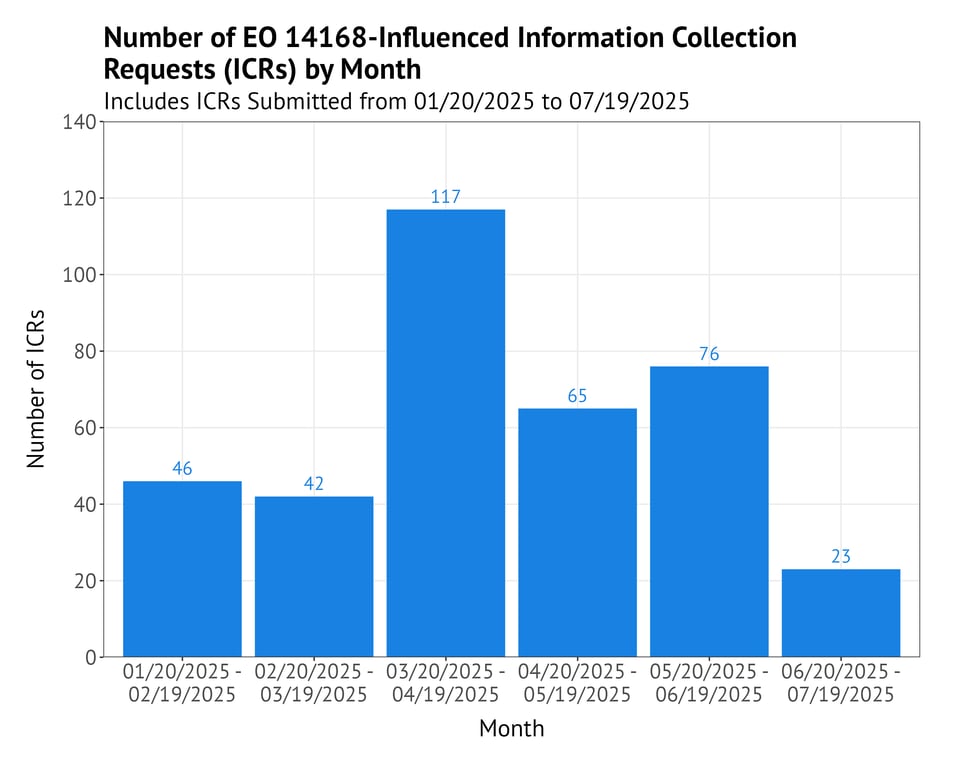
The consequences are not abstract. For example, some agencies have removed SOGI questions from programs focused on ending the HIV epidemic. When LGBTQ communities are no longer clearly visible in these data, their experiences and risks can be overlooked, even though these communities face some of the highest HIV rates due to longstanding structural inequities. When LGBTQ people disappear from these data, funding and services often disappear too, making it harder to stay healthy and safe.
When you remove those data you make it harder to see disparities and easier to deny they exist.
Melanie: How could these changes happen so quickly and quietly?
Caroline: A lot of it comes down to process. While some removals (17%) triggered formal opportunities for public input, the vast majority of changes (83%) were classified as “non-substantive”, meaning they didn’t require a public comment period. Although the removal of SOGI data elements is meaningful and impacted hundreds of collections, most changes were treated like technical tweaks. Many revisions, such as replacing “gender” with “sex” did not require approval before immediate implementation.
That kind of procedural framing allows agencies to revise collections and remove questions very quickly and largely out of public view. It’s a good reminder that sometimes big policy shifts don’t happen through headline-grabbing legislation, but through quieter, impactful actions like administrative guidance.
Melanie: Before 2025, how much progress had actually been made on SOGI data?
Caroline: More than many people realize. The federal government has collected some SOGI data for decades, but often inconsistently. For example, race and ethnicity data are governed by a statistical policy directive that formally standardizes collection — something that has never existed for SOGI measures.
Meaningful progress on LGBTQ data inclusion took place under the Biden administration. For example, the Biden White House created a Federal Evidence Agenda on LGBTQI+ Equity, federal agencies developed SOGI data action plans, and the Office of Management and Budget issued guidance to help federal agencies collect SOGI data in a more standardized way.
It wasn’t flashy, but it reflected steady, methodical progress rooted in decades of research. The work centered on adding voluntary SOGI questions, strengthening privacy safeguards, upholding scientific rigor, and improving the quality of data used to guide policies and programs affecting communities facing known disparities — including in youth well-being, health care, housing, and homelessness.
In other words, the groundwork for a more consistent and responsible federal approach to LGBTQ data was beginning to take shape. However, the opportunity to fully realize the benefits of this approach has been cut short by the Trump administration’s recent rollbacks.
Melanie: Why does this matter so much for MAP and others?
Caroline: Because data are building blocks for understanding whether policies are working or failing.
If you want to know whether anti-bullying policies are actually protecting LGBTQ youth, you need data. If you want to know whether civil rights protections are being enforced equitably — and where harms are increasing — you need data. If you want to know whether food assistance programs are reaching LGBTQ people who qualify, you need data. If you want to know whether investments in health, housing, or workforce programs are making a measurable difference over time, you need data.
Without data, disparities don’t disappear. They just become harder to document and address.
When engaging with decision-makers, data help LGBTQ communities tell our stories and make the case for change. There’s a simple truth here: if people are not reflected in the data, they are often left out of the solutions.
When advocates spent years working to improve LGBTQ-inclusive data collection, they were doing it to build the evidentiary foundation for better policymaking and stronger accountability.
Melanie: What do these rollbacks mean for LGBTQ equity more broadly?
Caroline: They’re part of a broader policy agenda targeting LGBTQ people, especially transgender communities.
When you combine cuts to services like Medicaid, weakened civil rights protections, restrictions on medically necessary health care, the elimination of crisis intervention services, and access to accurate identification with the removal of data, you create a situation where harms are harder to detect and harder to challenge. Eliminating data can function as a form of erasure. It becomes easier to say, “We don’t see a problem” when you’ve stopped measuring it.
That doesn’t mean data alone can solve inequity. Advocacy, litigation, community organizing and leadership remain essential. But without reliable information, it becomes more difficult to design effective responses, to hold systems accountable, and to meet real needs.
Melanie: What can we do about all of this?
Caroline: A lot of people feel overwhelmed right now, but there are real levers we can use to make change.
First, litigation has been essential. Lawsuits like Doctors for America v. OPM aren’t just technical fights about websites. They’re about protecting scientific integrity and preventing agencies from quietly dismantling data systems and information that communities rely on. Other cases, like Center For Taxpayer Rights v. Internal Revenue Service are pushing back against efforts to weaken privacy safeguards and the misuse of data to surveil, control, and punish underserved communities, especially immigrants. Courts aren’t a cure-all. But legal action can slow things down, create transparency, and in some cases stop harmful changes altogether.
Second, administrative advocacy still matters more than people think. Even in this environment, public input can shape outcomes. For example, when the administration attempted to remove a question on the National Crime Victimization Survey that allows people to report hate crimes motivated by anti-transgender bias, advocates mobilized. They submitted comments, built a public record, and raised visibility. And the administration reversed course. That’s important. It shows that engagement isn’t futile.
There’s also a quieter but critical layer of work happening: monitoring. Groups are tracking changes collection by collection and flagging when SOGI questions disappear, when “gender” is swapped for “sex,” or when a bias category is removed. Resources like dataindex.us and its monitoring of changes driven by Presidential Actions help make those invisible shifts visible. Without that oversight, many of these changes would go unnoticed.
So the response has been multi-pronged. Go to court when necessary. Use public comment tools strategically. Build a public record. Track and expose changes. Keep the pressure on. The throughline is that even when data are being removed, accountability mechanisms still exist. They just require vigilance and coordination!
Melanie: Your report also talks about misuse of data. That feels like a real tension — on the one hand we want data collected, on the other hand there are real risks. Can you say more about that?
Caroline: Although data can be powerful tools for advancing equity, when misused they can reinforce systems of oppression, deepen inequities, and cause real harm. We’ve seen attempts to misuse medical records or administrative data to target transgender people. We’ve also seen efforts to link data systems in ways that could expose immigrant communities to increased surveillance and immigration enforcement. In these cases, data originally collected to support public programs and service delivery are being repurposed for surveillance state control.
So the answer is not “collect everything.” It’s “collect responsibly” using robust data governance and privacy frameworks. That means collection for a clearly defined purpose. Voluntary participation. Strong privacy and confidentiality safeguards. Transparent governance. And most importantly, guardrails against weaponization.
The goal is not to collect data for data’s sake. It’s to generate information that helps people access services, enforce civil rights, conduct research, and improve well-being – without putting the subjects of that information at risk.
MAP's recent report highlights some approaches to ensure data are governed with care, transparency, and accountability, but also directs readers to resources from organizations that specialize in data governance and privacy, such as the Actionable Intelligence for Social Policy and Center for Democracy & Technology.
Melanie: If the federal government is stepping back, what can others do?
Caroline: State and local governments, community-based organizations, non-profits, and academic institutions have important roles to play in filling information gaps, so long as strong safeguards are built in from the start. They can invest in statewide surveys, needs assessments, and community-based research. Research like the U.S. Transgender Survey shows what’s possible when data collection is community-led and grounded in trust.
But transparency is key. People need to know why information is being collected, how it will be used, and what legal and privacy protections are in place. Being transparent builds trust, and trust is absolutely critical right now. Partnering meaningfully with community-based organizations — and developing clear, accessible outreach materials — can help ensure people are informed and feel empowered to decide whether and how they want to participate.